
Property Tax Assessments · November 21, 2026
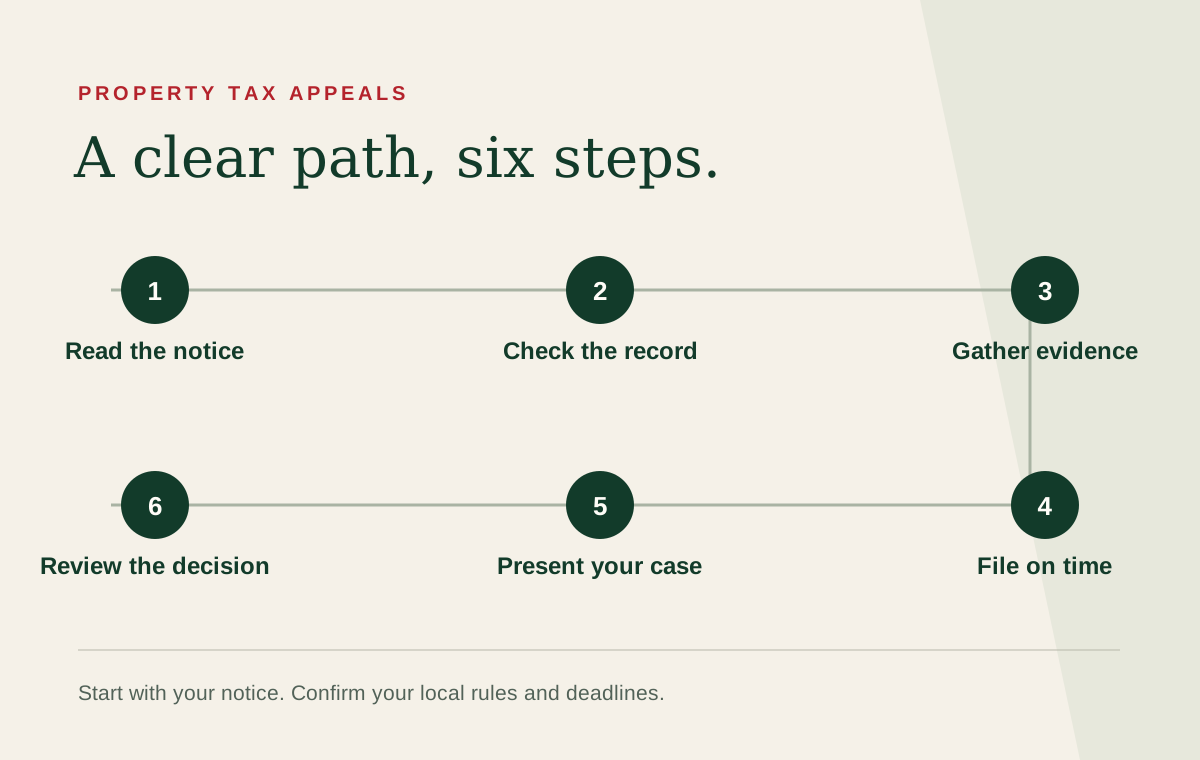
The 6 Steps of a Property Tax Appeal
A plain-English walkthrough for homeowners and commercial property owners.
A property tax appeal starts with a specific question: does the assessment accurately reflect your property under the rules that apply to it? A larger bill deserves a closer look, but the strongest case explains what is wrong and supports the requested correction with records.
For homeowners and commercial property owners, the process becomes easier to manage when it is broken into six steps. Begin with the notice, check the facts, and build a clear record before filing. National Tax Consultants offers property tax appeal support if you need help reviewing that information.
These steps provide a starting point, not a nationwide filing rule. Assessment methods, deadlines, and hearing procedures vary. Assessed value may reflect a ratio, limitation, or other local rule rather than equal current market value directly.
1. Review Your Assessment Notice
Read the notice as soon as it arrives. Confirm the owner name, property address, parcel number, assessment year, and values listed for land and improvements. Make sure you are reviewing the property and year you intend to challenge. Save the envelope and an electronic copy of every page.
Identify the valuation date as well as the appeal deadline. The valuation date tells you when the property's condition and value are being measured. The filing deadline tells you when to act. They serve different purposes, and evidence about a later change may not establish value for the period being reviewed.
Do not borrow a deadline from another county or a previous year's notice. For example, Maryland's assessment appeal guidance gives owners 45 days from the notice date for an appeal on reassessment. That example is specific to that process, not a national appeal window.
- Valuation date: When the property is being valued.
- Filing deadline: When the appeal must be submitted or received, as local rules require.
- Evidence deadline: When supporting records must reach the reviewing office.
If any instruction is unclear, ask the office named on the notice. Record the answer, the person's name, and the date. Then create a reminder early enough to prepare and deliver the filing without relying on the final day.
2. Check Your Property Record for Errors
Request the property record card or open the assessor's online record. Compare its description with the actual property and documents you already hold. Start with measurable facts: building area, lot size, construction year, bedroom and bathroom counts, and the presence of a garage, basement, or addition.
Read the labels carefully. A basement, finished basement, and finished living area may be recorded differently. Before claiming that square footage is wrong, ask how the assessor defines that field. A mismatch in terminology can look like a factual error when the underlying measurement is correct.
Next, review condition and improvements. Does the record describe a renovation that was never completed? Does it overlook a documented condition issue? Collect plans, measurements, dated photographs, or other records that show the difference. Avoid relying only on a statement that the property is older or less attractive than nearby homes.
Make a short correction log with three columns: what the record says, what you believe is correct, and what proves it. Keep the original record unchanged so the reviewer can see the comparison. Separate confirmed errors from questions that need further investigation.
A correction may affect value, but that effect still needs review. For a home, our residential property assessment service explains the kinds of property details a closer assessment review considers.
3. Gather Your Evidence
Build the evidence around the reason for your appeal. If you dispute the recorded size, provide reliable measurements. If you dispute value, explain which facts support a different figure under the applicable valuation method. A thick folder is less useful than a short, well-supported explanation.
For comparable sales, look for properties with meaningful similarities in location, size, age, use, and condition. Note sale dates and whether the transactions fit the period your local rules require. Asking prices can show what a seller hopes to receive, but they are different from completed sales. Explain those distinctions in your notes.
Do not select a property solely because it sold for less. Record important differences, such as a smaller lot, major repairs, or a different location. If you cannot explain a price adjustment reliably, describe the difference rather than inventing a precise dollar amount.
- Incorrect property details: Record card, plans, and documented measurements.
- Condition affecting value: Dated photos, inspection findings, and written repair estimates.
- Different supported value: Relevant completed sales, appraisal analysis, or appropriate financial records.
For condition problems, pair photographs with context. Identify the room or area, explain the issue, and show when it existed. A repair estimate helps describe the work, but repair cost does not automatically equal the change in property value.
Commercial owners may need rent rolls, leases, vacancy information, and operating statements, depending on the valuation approach. Keep periods consistent and distinguish recurring expenses from unusual items. Our commercial property tax appeal information outlines the importance of income, use, and property-specific facts.
Number exhibits and keep a simple index. Check local evidence requirements before paying for an appraisal or assembling a large packet.
4. File Your Appeal on Time
Use the correct form for the property, assessment type, and year. Confirm which office accepts it, which delivery methods are allowed, and whether a fee or authorization is required. The assessor who answers your questions may not be the office that receives a formal appeal.
An informal conversation can help clarify a record or resolve a disagreement. It should not become a reason to lose track of the filing deadline. New York's grievance procedures distinguish informal discussions from the formal grievance. For the RP-524 process outside New York City and Nassau County, the complaint must be received by the applicable deadline. Do not assume mailing on the last day is sufficient.
Before submitting, check the parcel number, owner information, assessment year, requested value or correction, signature, and attachments. If someone will act for you, confirm what authorization the reviewing office requires. Ask how additional evidence is handled if it is not due with the initial form.
Save exactly what you submit, including attachments. Keep the online confirmation, delivery receipt, or other accepted filing proof in the same folder. Check that the submission was accepted rather than only started. If a confirmation contains a case number, use it on later correspondence and add the next deadline to your calendar.
5. Present Your Case at the Hearing
Read the hearing notice before preparing your presentation. Confirm the format, attendance rules, evidence exchange instructions, and any time limit. For a phone or video hearing, test your connection and keep the notice, exhibits, and contact information within reach.
Prepare a short opening statement: identify the property, explain the assessment you dispute, state the correction or value you request, and name the strongest supporting facts. Then walk through the evidence in the same order as your index. Practice explaining the case without reading every document aloud.
Focus on the property and the applicable assessment rules. A difficult household budget or disagreement with public spending does not establish a different property value. When comparing properties, explain why the examples help evaluate your own property rather than simply pointing to lower numbers.
Expect questions and listen to the assessor's explanation. If a document supports your answer, give its exhibit number. If you do not know an answer, say so and ask whether the procedure allows a later response. Guessing can weaken an otherwise clear case.
Be realistic about possible outcomes. California's assessment appeals FAQ explains that its boards can leave a value unchanged, lower it, or raise it. Check the authority and risks of the particular review process before proceeding.
6. Receive the Decision and Consider Next Steps
Keep the written decision and note when it was issued and received. Read the whole document, including the assessment year, final value, reasons given, and instructions for any further review. Compare the result with your request so you understand what was accepted and what was not.
If the assessment changes, ask how and when that change will appear in the tax record and bill. A value reduction does not translate into the same percentage reduction in the final bill. Exemptions, assessment limits, tax rates, and other local rules may affect the result.
- Assessment changed: Confirm the updated record and ask about billing adjustments.
- Assessment unchanged: Review the reasoning and compare it with your evidence.
- Further review considered: Check eligibility, costs, required help, and the next deadline promptly.
If you disagree, investigate the next available route before its deadline passes. Further review may involve a different body, procedure, or need for legal advice. Do not assume that the next stage accepts the same filing or permits new evidence.
Keep tax payment dates on your calendar throughout the appeal. The California Board of Equalization expressly says taxes remain payable while an appeal is pending. Check your own payment obligations with the collecting office.
Your before-you-file checklist
Use this final review to catch gaps while there is still time to address them:
- The notice matches the correct property, parcel, and assessment year.
- You have confirmed the deadline, filing office, and accepted delivery method.
- Each disputed fact has a supporting document or a clear explanation.
- Your requested change follows the applicable assessment method.
- The form is complete, signed, and accompanied by required attachments.
- You have copies, a plan to retain filing proof, and reminders for later dates.
How National Tax Consultants can help
National Tax Consultants reviews assessment records, property details, and supporting information to help owners understand whether a closer look is warranted. A useful review starts with the notice and the facts, then considers what the evidence supports.
If you are unsure where to begin, contact our team with your property location, assessment notice, and stated deadline. We can discuss the information needed for a review and the appropriate next step. An appeal should be a reasoned decision based on your circumstances, without a promise of a reduction or refund.
Property tax appeal questions
Can I appeal because my property tax bill increased?
Start by finding out why the bill changed. An assessment appeal challenges the assessment under local rules. A higher tax rate, a change in an exemption, or another billing issue may require a different process. Compare the notice and bill before choosing your next step.
What evidence should I bring to a property tax appeal?
Bring documents that support the specific change you request. These may include property records, dated photographs, repair estimates, comparable sales, an appraisal, or income and expense records for a commercial property. Check the local rules for what is accepted and when it must be submitted.
Does an informal review replace a formal appeal?
Do not assume it does. Ask the local office whether you must also file a formal appeal to preserve your rights. Keep track of the formal deadline while discussing the assessment, and get any agreement or filing instructions in writing.
Will a successful appeal automatically produce a refund?
A lower assessment does not guarantee a refund or a particular tax savings amount. The effect depends on the tax year, local billing rules, applicable assessment ratios, and other parts of the tax calculation. Read the decision and ask the billing office how any adjustment will be handled.
Disclaimer: This article is for general educational purposes only and is not tax or legal advice. Appeal procedures, deadlines, and evidence requirements vary by state and county. Check with your local assessor's office or a qualified professional about your specific situation.
Related posts

How to Appeal a Property Tax Assessment
A step-by-step way to review the notice, collect useful evidence, and prepare for a local assessment appeal.
Read article →
Should I Appeal My Property Tax Assessment?
A practical way to decide whether the assessment, the evidence, and the deadline make an appeal worth pursuing.
Read article →